
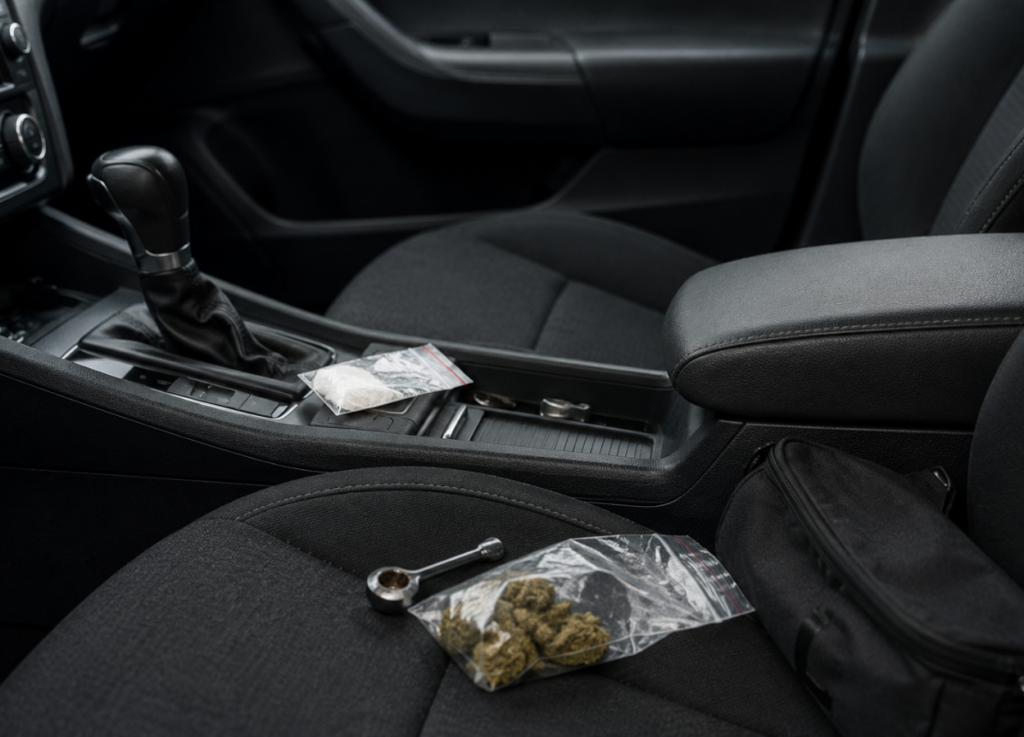
A traffic stop can turn serious very quickly once police start searching a vehicle. The situation becomes even more complicated when there are multiple people inside the car and officers discover drugs somewhere in the vehicle.
That is usually when everyone starts looking at each other.
A lot of people assume police can only arrest the person actually holding the drugs. Others think passengers are automatically protected because the vehicle does not belong to them. In Indiana, neither assumption is necessarily true. Drug cases involving shared vehicles often come down to what police believe each person knew, where the drugs were located, and whether prosecutors think someone had control over them.
These cases are messy because there is rarely a clean answer. Officers are trying to piece together what happened in real time during a roadside stop, often while several people are giving conflicting stories or refusing to answer questions entirely.
Why Shared-Car Drug Cases Become Complicated So Fast
Imagine police stop a car with four people inside. During the search, officers find a bag of pills underneath the passenger seat and a scale in the center console. Nobody claims ownership. One person says they just got into the car ten minutes earlier. Another says the vehicle belongs to a cousin. The driver insists they had no idea anything illegal was inside.
From the officer’s perspective, that immediately becomes a constructive possession investigation.
Indiana law does not always require prosecutors to prove someone physically held the drugs. Instead, they may try to show the person knew the drugs were there and had the ability to control them. That gives prosecutors broad room to argue that more than one person inside the vehicle was connected to the narcotics.
This is where many people get blindsided. Someone who never touched the drugs may still leave the traffic stop in handcuffs.
Does the Driver Automatically Get Charged?
Not always, but drivers usually face the most scrutiny because they control the vehicle itself. If drugs are found in obvious locations like the center console, beneath the driver’s seat, or mixed with the driver’s personal belongings, police may immediately assume the driver knew about them.
Real life is rarely that simple, though. Cars get borrowed. Friends leave items behind. Multiple people use the same vehicle throughout the week. In some situations, the driver genuinely has no idea what another passenger brought into the car.
Police are still likely to pressure the driver heavily during questioning because investigators often believe the driver is the easiest person to connect to the vehicle and its contents.
What people say during these moments matters more than they realize. Nervous explanations, inconsistent timelines, or attempts to distance themselves too aggressively sometimes end up strengthening the prosecution’s case later.
Passengers Can Still Be Arrested
Passengers often assume they are safe because the drugs were not found directly on them. That assumption leads to a lot of shocked reactions during traffic stops.
If officers believe a passenger knew drugs were inside the vehicle, charges may still follow. Police look at everything surrounding the stop:
- where the drugs were located,
- who appeared nervous,
- whether anyone made suspicious movements,
- whose belongings were nearby,
- and whether phones or messages appear connected to drug activity.
Sometimes officers arrest everyone first and let prosecutors sort through the evidence later. Other times, police focus primarily on one occupant based on statements or where the narcotics were discovered.
Shared vehicles create gray areas, and prosecutors often rely heavily on circumstantial evidence to fill those gaps.
The Search Itself May Become a Major Issue
A lot of these cases turn on the legality of the traffic stop and search rather than the drugs themselves.
Police may claim they smelled marijuana, saw paraphernalia in plain view, or obtained consent to search the vehicle. In other cases, officers extend the stop while waiting for a K-9 unit or continue questioning occupants long after the original purpose of the stop should have ended.
Those details matter.
If constitutional violations occurred during the stop or search, certain evidence may potentially be challenged later. That is one reason the timeline of what happened during the stop often becomes extremely important in shared-car drug investigations.
People frequently focus only on whether the drugs belonged to them. Meanwhile, the legality of how police found the evidence may end up being just as important to the case.
What if Someone Else Admits the Drugs Were Theirs?
Even when one person claims ownership, police may still investigate everyone else in the vehicle. Prosecutors sometimes argue multiple people were involved or that others still exercised control over the narcotics.
For example, if officers believe drugs were being transported for distribution, they may continue examining:
- text messages,
- cash found in the car,
- packaging materials,
- GPS history,
- or phone communications between occupants.
One confession does not necessarily stop the investigation from expanding.
At the same time, there are situations where another person’s admission significantly changes the direction of the case. Every shared-car investigation depends heavily on the specific facts, statements, and evidence involved.
These Cases Often Feel Different Once Charges Are Filed
At the roadside, people usually focus on the immediate panic of the stop itself. Once formal charges appear, the situation suddenly feels much more serious.
Even lower-level drug possession allegations can affect:
- employment opportunities,
- probation status,
- housing applications,
- professional licenses,
- and future criminal sentencing exposure.
Felony drug charges carry even steeper consequences, especially in cases involving fentanyl, methamphetamine, cocaine, or allegations of intent to distribute.
What surprises many people is how aggressively prosecutors may pursue cases built largely on assumptions about who knew what inside the vehicle.
Drugs Found During a Traffic Stop in Indianapolis?
Shared-vehicle drug investigations are rarely as straightforward as police initially make them seem. Prosecutors still need evidence connecting someone to the alleged narcotics, and those cases often involve disputes over ownership, knowledge, searches, and constructive possession theories.
Hayes Law Office has spent more than 20 years defending clients throughout Indiana facing drug possession allegations, felony narcotics charges, paraphernalia cases, and other criminal accusations arising from traffic stops and vehicle searches.
Attorney Philip Hayes and the team at Hayes Law Office have earned more than 300 five-star reviews from former clients across Indiana. Early defense strategy can make a major difference in shared-car investigations where police and prosecutors are trying to determine who they believe the drugs belonged to.